The short answer: reading the whole Bible at a steady, unhurried pace takes most people around 72 hours in total. Spread that across a year and it works out to roughly 15 minutes a day.
Read faster and you can finish in a few months. Read slowly, pausing over names and places, and the same text may take you over a year.
This guide gives you the exact numbers, a daily-time table for every pace, and honest plans for 30 days, six months, and one year — plus where to read when you need a boost along the way.
The Quick Answer
Here is the whole article in one box:
| Question | Answer |
| Total silent reading time | About 72 hours (roughly 70–75) |
| At 15 minutes a day | About 9–10 months |
| At 30 minutes a day | About 5 months |
| At 3–4 chapters a day | About 1 year |
| Total chapters | 1,189 |
| Total chapters in the Old Testament | 929 |
| Total chapters in the New Testament | 260 |
| Listening instead of reading | About 75–90 hours |
That is the shape of it. The rest of this article explains where each number comes from and how to build a plan around it.
How Many Words and Chapters Are in the Bible?
Two numbers do most of the work here.
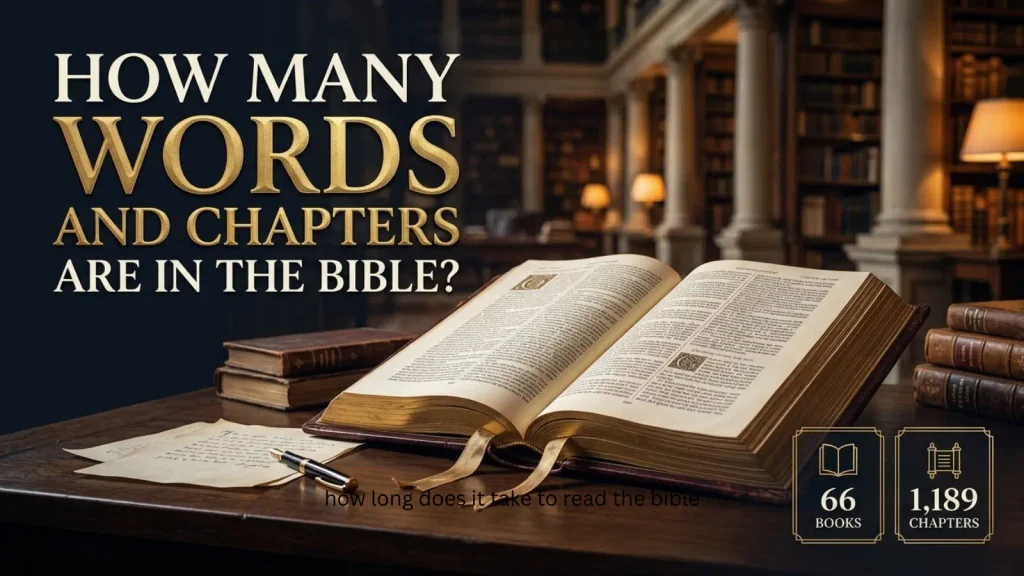
The Protestant Bible contains 66 books — 39 in the Old Testament and 27 in the New — and 1,189 chapters. Of those chapters, 929 sit in the Old Testament and 260 in the New Testament. The verse total comes to 31,102 Wikipedia — Chapters and verses of the Bible.
By word count, the King James Version runs to roughly 780,000 words, though published counts vary between about 783,000 and 790,000 depending on the edition and on whether chapter headings and book titles are included Bible Memory Goal — Bible word count.
Now a useful surprise. If you divide 790,000 words by the average adult silent reading speed of about 238 words per minute, you get roughly 55 hours. Yet almost every serious estimate lands higher, between 70 and 75 hours. Why?
Because no one reads genealogies, lists of tribal names, and Hebrew poetry at full speed. Your eyes slow down. The commonly cited figures — 70 hours 40 minutes from one detailed count, and about 74.5 hours from another — reflect real reading, not sprint reading ICC Campus — How long to read the whole Bible, Theos — How long to read the Bible.
Working figure for this article: 72 hours — about 4,320 minutes.
How Long Does It Take? A Table for Every Pace
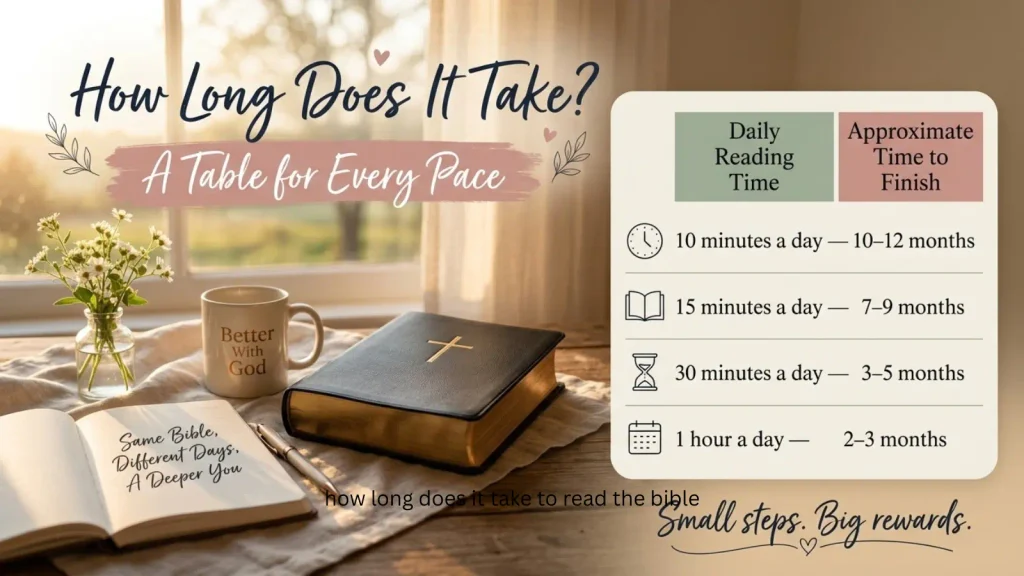
The table below is built from that 72-hour total. Find the row that matches the time you can honestly give each day.
| Daily reading time | Time to finish |
| 10 minutes | About 14 months |
| 15 minutes | About 9–10 months |
| 20 minutes | About 7 months |
| 25 minutes | About 6 months |
| 30 minutes | About 5 months |
| 45 minutes | About 3 months |
| 1 hour | About 2.5 months |
| 2 hours | About 5–6 weeks |
How to read this table honestly: these are averages, not promises. A faster reader can pull every row closer, and a reader who looks up every new name will push them further out. If you naturally read slowly, move one row up. If you skim comfortably, move one row down.
Four of these are worth noting:
- 15 minutes a day is the sweet spot for most people. It fits in a coffee break.
- 10 minutes a day still finishes the Bible — just not in a year. It takes about 14 months.
- 30 minutes a day is where real momentum starts: about 5 months.
- 1 hour a day puts the whole Bible inside one season of your life.
How Long Does It Take to Read the Bible in One Year?
A one-year plan is the most popular approach, and the numbers are friendly.
With 1,189 chapters in front of you and 365 days on the calendar, you need about 3.3 chapters a day — call it three or four. At a normal pace that is roughly 15 to 20 minutes, and it leaves room to think about what you read rather than racing past it Crossway — You can read more of the Bible than you think.
Three things make a one-year plan survive contact with real life:
- Fix a time, not just a goal. Before breakfast or before bed works for most people. A plan without a time slot usually collapses in week three.
- Pick a chapter target, not a page target. Chapter lengths vary wildly, so chapters travel better between Bible editions than pages do.
- Let a missed day stay missed. Trying to “catch up” by doubling the next day is the fastest route to quitting. Just carry on from the same place.
If a full year feels too slow and a month feels too fast, a 90-day plan is the middle road: about 48 minutes a day, or roughly 13 chapters.
How Long Does It Take to Read the Old and New Testaments?
The two testaments are very different in size, and reading them separately changes the maths.
The Old Testament
The Old Testament holds 39 books and 929 chapters — about three-quarters of everything you will read. Expect roughly 52 to 55 hours.
It also contains the sections most likely to slow a first-time reader: the laws of Leviticus, the censuses of Numbers, and long genealogies. If a passage feels dense, shrink your section rather than your session. Read one paragraph and look up the names in it, then move on.
The New Testament
The New Testament has 27 books and 260 chapters — around a quarter of the total. Expect roughly 18 to 20 hours.
That is genuinely short. For scale, the four Gospels plus the book of Acts together take about 10 hours, which means the entire life of Jesus and the birth of the early church fits into two weeks of 45-minute sessions Crossway.
If you are new to Bible reading and want to start where the story is clearest, begin with Mark. It is the shortest Gospel and moves quickly. Then go back to Matthew and Luke, and finish with John.
A useful check: 55 hours for the Old Testament plus 18 for the New gives 73 hours — which matches the 72-hour figure used throughout this article.
Can You Read the Bible Faster?
Yes, but faster is not automatically better, and it is worth being clear about the trade.
If your aim is the whole story in one sweep — how the narrative fits together, how the prophets and the Gospels connect — then speed helps. A 30-day plan is possible, and it teaches you the shape of Scripture in a way slow reading rarely does.
If your aim is understanding a single passage — what a verse means and how to live it — then speed works against you. You need to stop, sit with an unfamiliar name, and ask what the writer was doing.
Most long-term readers do both, at different seasons. Read the Bible fast once, so you stop being intimidated by it. Then read it slowly for the rest of your life.
Where to Turn When You Want More Than a Plan
A reading plan tells you when to read. It does not always tell you where to turn when you are tired, grieving, or grateful. For those days, these four collections are worth keeping nearby — and they are the pages our readers return to most often.
Bible verses of encouragement
When the schedule feels heavy and you need a reason to keep opening the book, this collection of Bible verses of encouragement gathers passages about strength, patience, and God’s nearness. It pairs well with the harder stretches of the Old Testament.
Healing verses in the Bible
Illness and grief interrupt reading plans. On those days, the healing verses in the Bible offer passages about restoration, comfort, and hope — the kind of reading that does not need a target, only attention.
Bible verse about prayer
The Gospels record Jesus praying more often than most readers expect. A single Bible verse about prayer makes a good anchor for the moments when you want to respond to what you have read rather than simply continue.
Bible verses of wisdom
Proverbs and Ecclesiastes are the parts of the one-year plan people tend to rush. They are also the parts worth slowing down for. These Bible verses of wisdom collect the practical sayings in one place, useful for reading a line a day instead of a chapter.
Preparing to Read: Five Habits That Hold
A plan is only as strong as the habits around it. These five carry most readers through a full year:
- Keep the Bible where you will see it. On the desk, or by the bed. Visibility beats willpower.
- Protect a fixed slot. Same time daily. A plan anchored to a time survives; a plan anchored to “when I get a chance” does not.
- Silence the phone for those minutes. This is the single biggest reason plans fail.
- Write one line after each session. Not a summary — just one thing you noticed. It keeps you awake to the text.
- Read with someone. Even one other person asking “what did you read today?” changes the odds considerably.
And one permission slip: you do not have to match anyone else’s pace. The goal is to understand what you read, not to finish before your neighbour does.
Listening Instead of Reading
You can also hear the whole Bible. An audio Bible runs longer than silent reading because narration moves at roughly 150 to 180 words per minute. Complete recordings come in at about 75 hours, with dramatised or multi-voice editions reaching as high as 89 hours MegaVoice — Is listening the same as reading?.
Listening is not a shortcut, but it is a genuine alternative — useful for commutes, chores, and anyone who finds sitting still difficult. You can pause, replay, and pick up exactly where the narrator left off.
Frequently Asked Questions
How long does it take to read the whole Bible?
About 72 hours at a steady silent reading pace. Published estimates usually fall between 70 and 75 hours. Faster readers can finish nearer 55 hours; slower readers who pause over names and genealogies may take 90 hours or more.
How long does it take to read the Bible in one year?
You need about 3–4 chapters a day, roughly 15–20 minutes, to work through all 1,189 chapters in twelve months.
Can I read the whole Bible in 30 days?
Yes, but it is demanding. You would need about 2.5 hours a day, reading roughly 40 chapters a day. Plan your time carefully before you begin, and expect the genealogies to slow you down.
How long does it take to read the Bible in 90 days?
About 48 minutes a day, or roughly 13 chapters daily.
How long does the Old Testament take to read?
The Old Testament has 929 chapters and takes about 52–55 hours.
How long does the New Testament take to read?
The New Testament has 260 chapters and takes about 18–20 hours. The four Gospels plus Acts alone take about 10 hours.
How many chapters should I read each day?
For a one-year plan, aim for three to four chapters. For six months, about six to seven. For 90 days, around thirteen.
Is it better to read the Bible quickly or slowly?
Both have their place. Read it quickly once to see the whole story; read it slowly afterwards to understand it. The mistake is doing only one of the two.
Is listening to the Bible as good as reading it?
Listening is longer — about 75 to 90 hours — because narration sets the pace. But it still counts, and for many people it is the habit that actually lasts.
Which book should I read first?
Mark if you want to meet Jesus first in the shortest account. Genesis if you want to read the Bible in order from the beginning.
Final Thoughts
So, how long does it take to read the Bible? At a steady pace, about 72 hours — 9 to 10 months at fifteen minutes a day, five months at thirty, and longer if you read slowly.
But the number matters less than the rhythm. Choose a daily slot you can actually keep, take three or four chapters, and let the days accumulate. Some sessions will feel rich; others will feel like walking uphill through a genealogy. Both count.
A Bible finished in fourteen months is worth more than a plan abandoned in February. Start smaller than you think you should, and keep going.

Mary Elizabeth writes heartfelt Christian content focused on faith, prayer, hope, and the teachings of Jesus Christ to encourage and inspire believers.
